
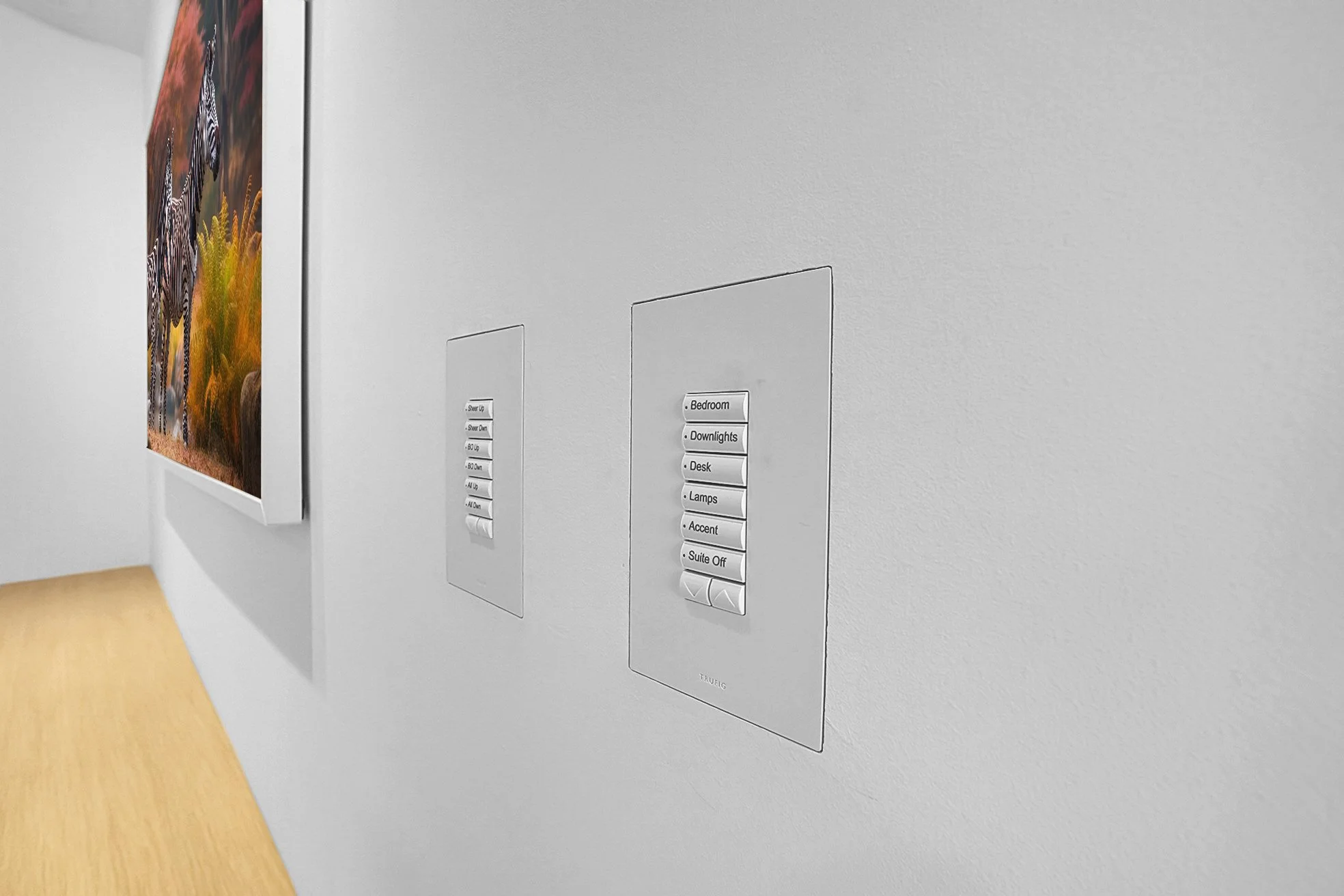
Most homes don't have an automation problem. They have a coordination problem. The lights are on one app, the shades on another, the thermostat on a third, the music on a fourth, and the cameras somewhere the homeowner has to look up. Automation is what happens when those systems stop being separate.
Whole-Home Automation and Control
What Automation Actually Does
One button that takes the house from day to evening
Shades that close against the afternoon sun before the room heats up
Music that follows you from kitchen to lanai without stopping
Lights that come up at the right level at 6 a.m. and 11 p.m.
The house locked, dark, and set back when you leave with just one press
A guest suite that works the way your house does, without a tutorial
Why Most Systems Get Complicated
Automation goes wrong for one of two reasons: too much of it, or too little planning behind it.
Systems fail when every possible scene gets programmed and nobody remembers what any of them do. They also fail when devices are chosen individually over several years and asked to cooperate after the fact.
The homes that work are the ones where someone asked how the family actually lives, then built exactly that, and left out the rest.
How We Design a Control System
We start with your day, not the device list
When do you wake up, where do you spend evenings, what do you turn off on your way out. The system follows the routine that already exists.
We choose the control that fits the room
A keypad by the door, a touchscreen in the kitchen, voice where it makes sense, an app when you're away. Most rooms need one of these, not four.
We build on a platform that lasts
Professional control systems are supported for a decade or more, and they're serviceable. Consumer ecosystems change direction on their own schedule.
We program for the people who live there
Fewer scenes, better named, doing what you'd expect. If it takes explaining, it isn't finished.
What a System Can Bring Together
Lighting and lighting scenes
Motorized shades and drapery
Climate and multiple thermostat zones
Audio throughout the house and outdoors
Video, theater, and media rooms
Cameras, locks, and gates
Pool, spa, and landscape lighting
Away modes, arrival routines, and vacation settings
New Construction and Existing Homes
If you're building, control should be designed alongside lighting and electrical. Keypad locations, wire paths, and equipment space are decisions made at schematic design.
If you already own the home, automation is often additive. Many systems can be introduced in stages, starting with lighting or shades and expanding as budget and appetite allow.
Common Questions about home Automation
-
No. Well-designed systems are mostly buttons and routines. The app is for when you're not home.
-
Your system keeps running. Local control stays local. You lose remote access, not the house.
-
Sometimes. Some products integrate cleanly, others don't. We'll tell you which is which before you spend anything.
-
No. Starting with one system and expanding is common, as long as the foundation is planned for where you're headed.
-
That's normal, and it's part of a service agreement. Families change, and the programming should change with them.
Where We Work
Designed and installed from two offices — West Palm Beach, serving Palm Beach, Jupiter, Boca Raton, Delray Beach, Boynton Beach, Palm Beach Gardens, Wellington, Royal Palm Beach, and Juno Beach; and Vero Beach, serving Vero, Sebastian, Stuart, Palm City, Jensen Beach, Port St. Lucie, Hobe Sound, and Martin County.
Curious What This Would Look Like in Your Home?
Tell us how you use the house — where you spend evenings, what you're always getting up to adjust. We'll tell you what we'd build first.