
Lighting Control and Design
Lighting is the one system in a home that everyone notices and almost nobody discusses until the drywall is up.
By then the recessed cans are placed, the switch locations are set, and the conversation narrows to which dimmer goes on the wall. The room is already lit the way it's going to be lit.
The better conversation happens earlier — about what each room is for, at what hour, and what the architecture is trying to do with light in the first place.
What Good Lighting Design Solves
Rooms that feel flat at night despite plenty of fixtures
A wall of switches nobody can decode
Light that's too bright at 10 p.m. and too dim at 7 a.m.
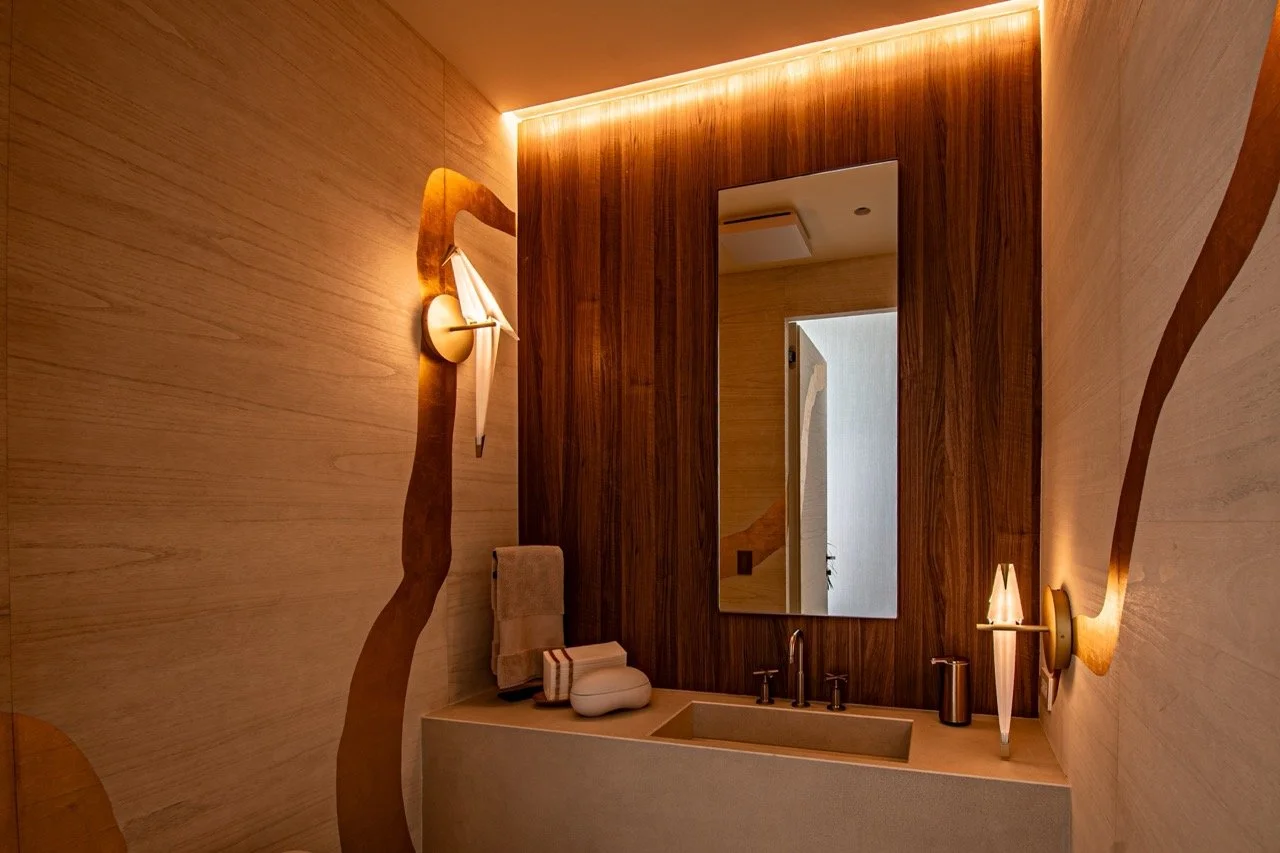
Art, millwork, and stone that disappear after dark
Glare on televisions and screens
Outdoor lighting that stops at the edge of the patio
Layers, Not Fixtures
A well-lit room uses several kinds of light doing different work.
Ambient light fills the space. Task light serves the counter, the desk, the reading chair. Accent light gives the room dimension like grazing a stone wall, lifting a piece of art, marking a stair. Decorative fixtures are the ones you actually see, and they carry the design.
Most homes have the first kind and some of the fourth. The two in the middle are what separates a room that works from a room that's merely bright.
How We Design a Lighting System
We work from the architecture
Ceiling planes, millwork, stone, and window walls determine where light can come from and what it will do when it gets there. The plan follows the drawings.
We design scenes around the day
Morning, working, entertaining, evening, late. A handful of settings, each doing something obvious, is more useful than dozens nobody remembers.
We reduce what's on the wall
Six switches by the door become one keypad with labeled buttons. Fewer decisions, in language that makes sense to the people who live there.
We specify for finish, not just output
Trimless, flush, color-matched, hidden. If a fixture is visible, it should look deliberate. Color temperature stays consistent across a room and across the house.
What a Lighting System Includes
Lighting design coordinated with your architect, designer, or lighting designer
Fixture specification, layout, and aiming
Dimming systems suited to the fixtures, not just any dimmer on any load
Keypad layout, engraving, and finish selection
Scene programming for daily use, entertaining, and away modes
Integration with shades, climate, audio, and the rest of the system
Landscape and exterior lighting, including path, facade, and pool
New Construction and Existing Homes
If you're building or renovating, lighting belongs at schematic design alongside electrical. Fixture placement, wire paths, and keypad locations are inexpensive decisions before drywall and disruptive ones after.
If the home is finished, wireless control systems have made retrofit far more practical than it once was. Many homes can be converted without opening walls, starting with the rooms used most.
Common Questions about home Lighting
-
Not always. Some existing fixtures dim well and some don't. We test before recommending a change.
-
Often, yes. Wireless dimming and keypads retrofit into existing boxes in most homes. New construction has more options, but a finished home isn't a barrier.
-
Yes. Every keypad works as a switch. Nothing requires an app or a scene to turn a light on.
-
It's part of the same system. Facade, path, pool, and dock lighting can run on the same schedules and scenes as the interior.
-
Fewer than most people expect. Four or five per room, clearly named, covers nearly everything.
Where We Work
Designed and installed from two offices — West Palm Beach, serving Palm Beach, Jupiter, Boca Raton, Delray Beach, Boynton Beach, Palm Beach Gardens, Wellington, Royal Palm Beach, and Juno Beach; and Vero Beach, serving Vero, Sebastian, Stuart, Palm City, Jensen Beach, Port St. Lucie, Hobe Sound, and Martin County.
Have a Project in Drawings?
Send us the set, or tell us which rooms never feel right after dark. We'll tell you what we'd look at first.